I’m very excited to have contributed a chapter on the antipassive in Babungo in this volume on RRG in African languages. Coming May 2023!
https://www.degruyter.com/document/isbn/9783110795295/html?lang=e
Conversational AI | Linguistics | Development
I’m very excited to have contributed a chapter on the antipassive in Babungo in this volume on RRG in African languages. Coming May 2023!
https://www.degruyter.com/document/isbn/9783110795295/html?lang=e
“Will you have a cup of tea?” – “No, no, no…” – “Go on, you will” – “No really, I’m fine!” – “You will, just a half-cup” – “Oh okay, just a half cup”.
This is a typical conversation you might witness upon entering an Irish home when I was growing up. The three to four turn polite decline, the modification of the offer, the giving in of the half-cup tea drinker. But in some cultures, this up front refusal of the offer may be interpreted as rude or ungrateful.
When designing virtual agents, be they chatbots or voice bots, an awareness of cultural context and social norms around areas such as politeness may make all the difference in a natural, seamless and comfortable user experience. Existing research in fields such as sociolinguistics can inform these design choices. Of course, nuance applies and not all generalizations will hold in every situation, but valuable insights are available to us if we consult the research!
For example, research by Hass & Wächter (2014) found that Japanese and German cultures present two opposite poles of a continuum when it comes to directness/indirectness of speech. A German communicative style favored the former – being more task oriented. The Japanese style favored the latter – valuing group orientation. Research on politeness has also been carried out in the setting of healthcare. Backhaus (2009) presents a cross-cultural comparative study of elderly care home interaction in Japan with elderly care home interactions in a range of different cultural and linguistic contexts. It was found, for instance, that praise, if applied out of context and in too exaggerated a manner, can be interpreted as another expression of the unequal power relations between residents and staff that characterize everyday life in the institution.
Consulting the research on topics like power dynamics and culturally specific values surrounding politeness are a valuable tool in the conversation designers kit.
What unique politeness principles are present in your culture?
Resources:
Hass & Wächter (2014) Culture and the Question of Impoliteness in Computer-Mediated Communication: a research gap. DOI: 10.18247/1983-2664/educaonline.v8n1p1-12
Backhaus (2009) Politeness in institutional elderly care in Japan: A cross-cultural comparison Journal of Politeness Research 5 (2009). DOI: 10.1515/JPLR.2009.004
Intents and slots are central to the Alexa skill building process, but what are they exactly?
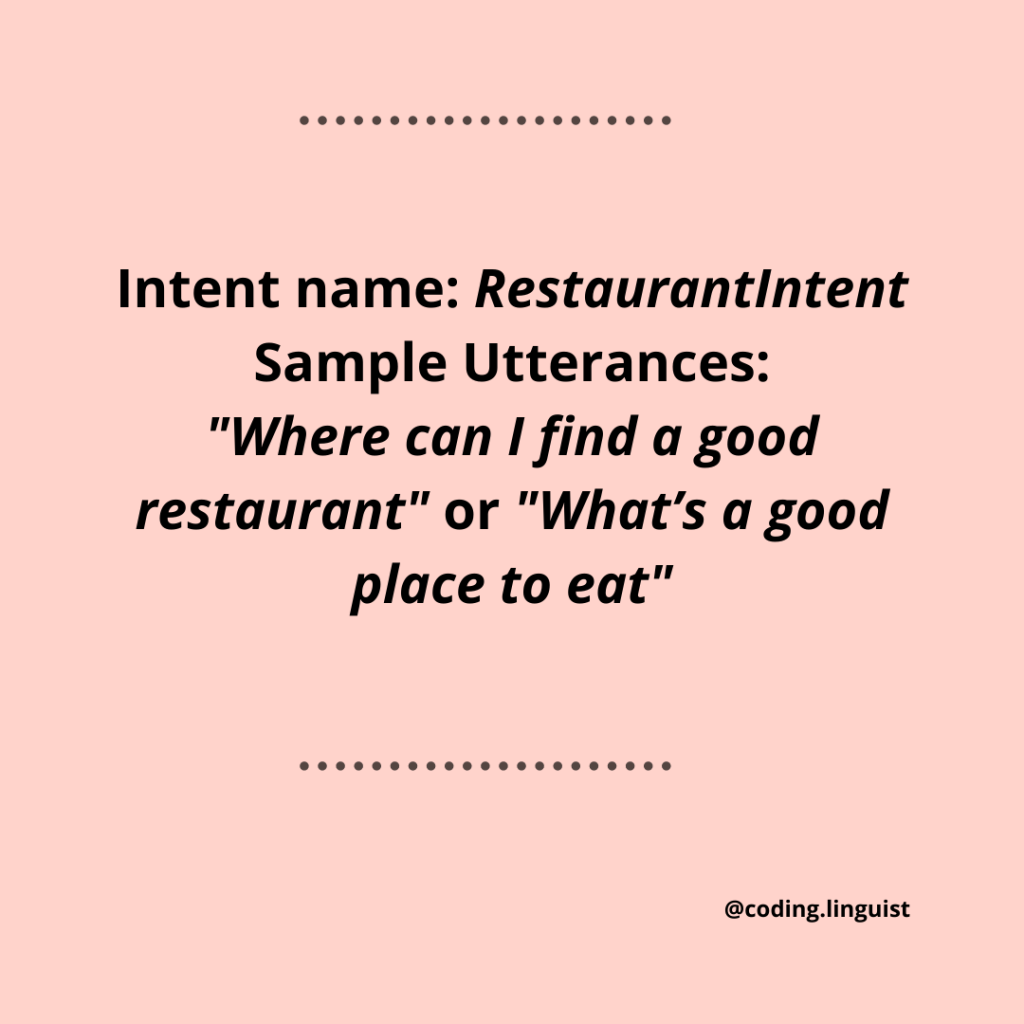
𝐈𝐧𝐭𝐞𝐧𝐭𝐬
Intents consist of names and a list of “utterances”. The latter are the various ways in which a user might ask Alexa a question.
For example,
Name: “RestaurantIntent” Utterances: “Where can I find a good restaurant” or “What’s a good place to eat”.
Machine learning processes will cater for many more ways in which customers might ask this based on the utterances you add.
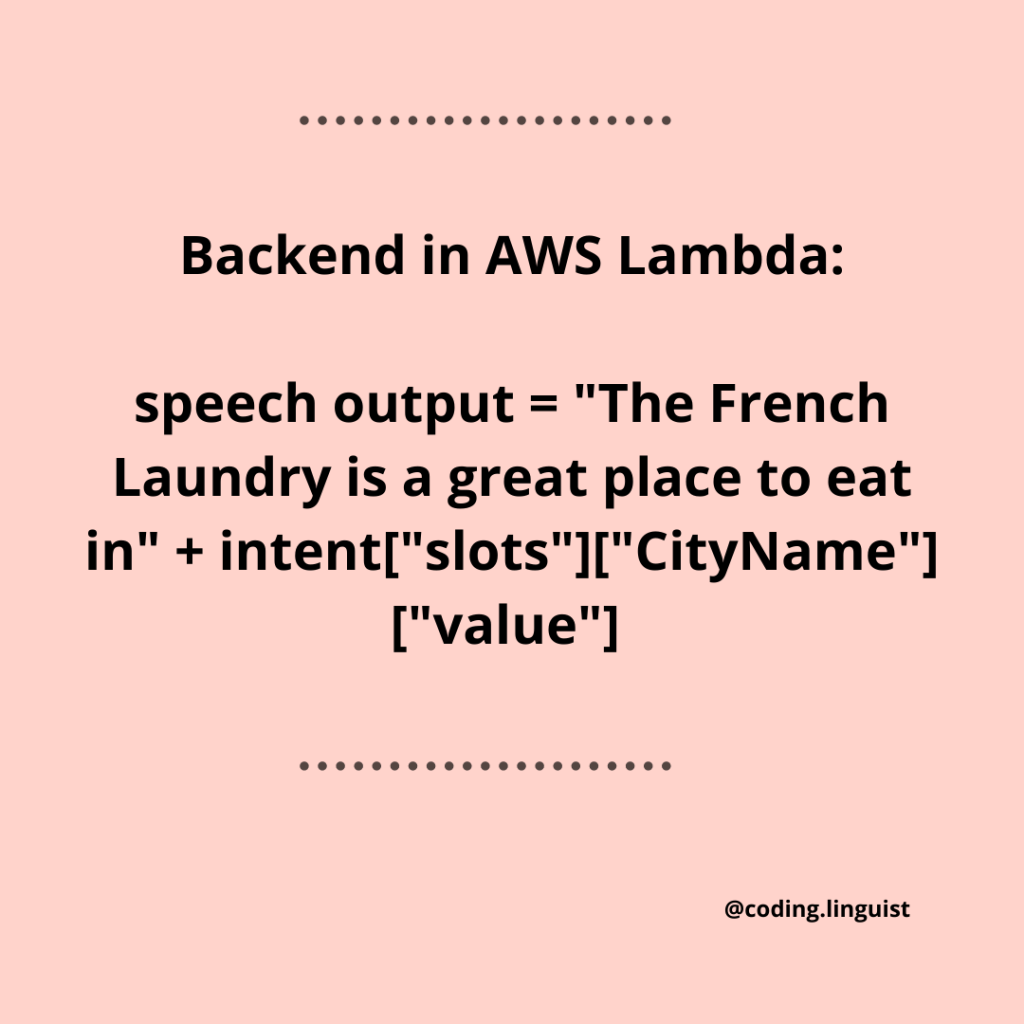
Each intent is “handled” at the backend, using AWS lambda for instance, and provides appropriate responses for each intent.
𝐒𝐥𝐨𝐭𝐬
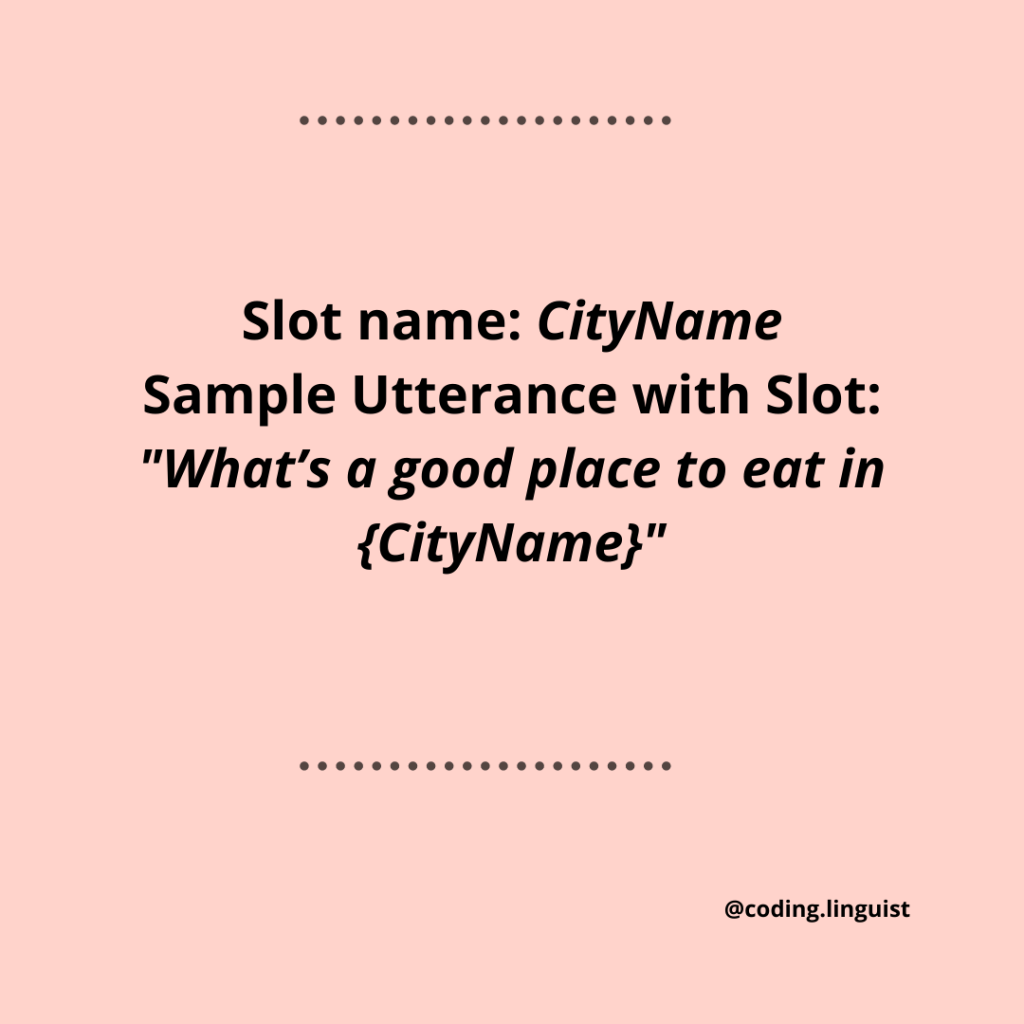
Words that express variable information such as names and locations can be allocated as slots.
Such words can be highlighted in the original utterance using curly braces {}
You can then create a new slot name such as StreetName
You then assign your slot name to a slot type such as dates or place names.
These types can be built-in or custom made.
Hope these snippets are helpful 🙂
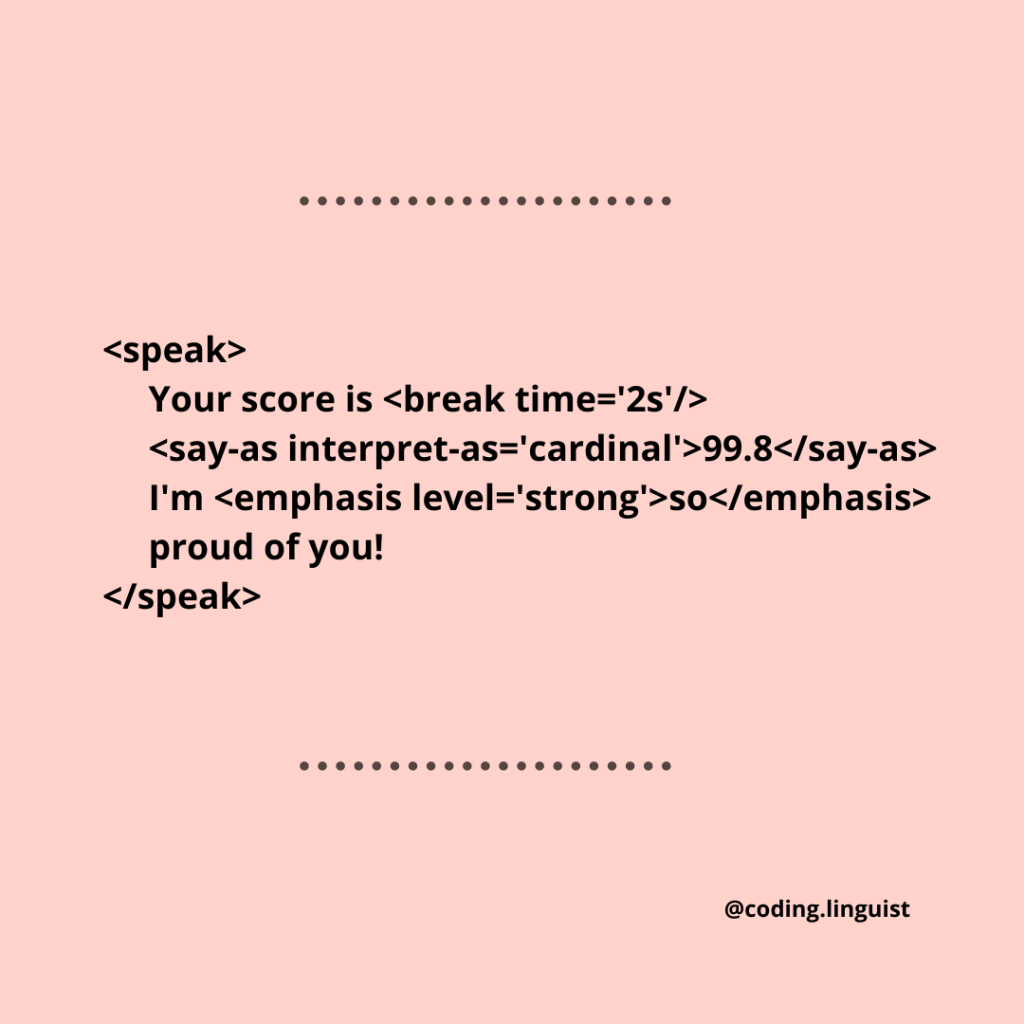
You’ve probably heard of HTML but possibly not SSML. Where HTML is used to describe the structure of a web page, SSML (Speech Synthesis Markup Language) is an XML based markup language used in speech synthesis applications. It controls aspects of synthesized speech such as pronunciation, emphasis, pitch and rate. The Alexa Skills Kit supports a subset of SSML tags to make your Alexa skill more personable and customizable. Cool features include things like adding emotions such as “excited” or the addition of audio files to your app. Note – If you’re using the Alexa Skills Kit SDK for Node.js or Java you don’t need to use the <speak> tags!
Have you used SSML before?
For more info on using SSML with your Alexa App check out this documentation: https://developer.amazon.com/en-US/docs/alexa/custom-skills/speech-synthesis-markup-language-ssml-reference.html
Form and function are familiar categories of language that address things like syntactic structure and the purpose of such in communication. Certain forms, for instance, the practice of shortening the form of very common words such as “woman” -> “women” rather than “woman” -> “womans”, are thought to be economical in our use of language and allow our brains to process them more effectively. Form and function are connected and we use syntactic and semantic tools to express this connection. A word, phrase or sentence that is frequently used can be made more economical to aid in comprehension as we saw in the case of “women”. Another example is iconicity, that is, when the utterance reflects the logical structure of the thing being described in the real world. It can help us to understand sentences quickly so that the purpose of our communication is carried out more readily. Take “the big brown wooden box”. Which of those attributes is most inherently true of the box? It could be wooden but black, or wooden and brown but small. The order of the adjectives is reflecting the level to which each is inherently true of the box the closer they get it it. This arguably helps us process such a logical reflection of the real world more effectively. For example, a parent telling a child who has dumped their red legos into the laundry basket to, “pick out all of the small red plastic blocks!”, might have better luck than the one asking that they, “ pick out the small blocks red plastic.”
For a more in-depth taste of my linguistic research on the Ring languages, the semantic feature of [Shape], and linguistic typology, check out the link below!
My article starts on page.8 😉
http://www.fresnostate.edu/artshum/linguistics/documents/WECOL%202018%20Proceedings_updated.pdf
 |
| The view from my hotel in Bamenda. I remember wondering if trees and landscapes like these shaped the perceptions and languages of indigenous speakers. |
“What is truth?” Pilate infamously enquired. It’s a topic that’s been wrangled with, debated, scoffed at and sometimes embraced. I fall into the category of believing that there is objective truth; right and wrong, fact and fiction. But, I also think that in an effort to defend objective provable truth some of us can fall prey to the fallacy of equating relativism with perspective.
 Ciara Anderson, PhD